

India has increased its claim in the Central Arabian Sea, as part of its ‘extended continental shelf’ by nearly 10,000 square km but also modified an earlier claim to avoid a long-standing dispute with Pakistan over the maritime boundary between the two countries.
Background: Coastal states, under the United Nations Convention on the Law of the Sea (UNCLOS), can claim up to 200 nautical miles (nm) of Exclusive Economic Zone (EEZ), granting them rights to fish, mine, and exploit marine resources. Beyond this, they can apply to extend their continental shelf if they can scientifically prove it continues under the sea.
India’s Original Claim: India had previously made a claim for an extended continental shelf in the Arabian Sea. However, parts of this overlapped with Pakistan’s claims — particularly near Sir Creek area in the Rann of Kutch — leading Pakistan to object in 2021.
- Sir Creek is a strip of water in the marshes of the Rann of Kutch in Gujarat.
Rejection and Modification: In March 2023, the Commission on the Limits of the Continental Shelf (CLCS) rejected India’s full Arabian Sea claim. However, the CLCS allows countries to submit “modified claims.”
India’s Response: On April 3, 2024, India submitted two partial modified claims:
- It increased its claim by around 10,000 square kilometers in the Central Arabian Sea.
- It adjusted claims in the Western Arabian Sea to avoid overlapping disputed areas with Pakistan.
Other Overlaps: Some parts of India’s claim still overlap with Oman’s continental shelf claims, and those issues may require separate negotiations or clarifications. (Source: The Hindu)
Maritime zones and rights under UNCLOS
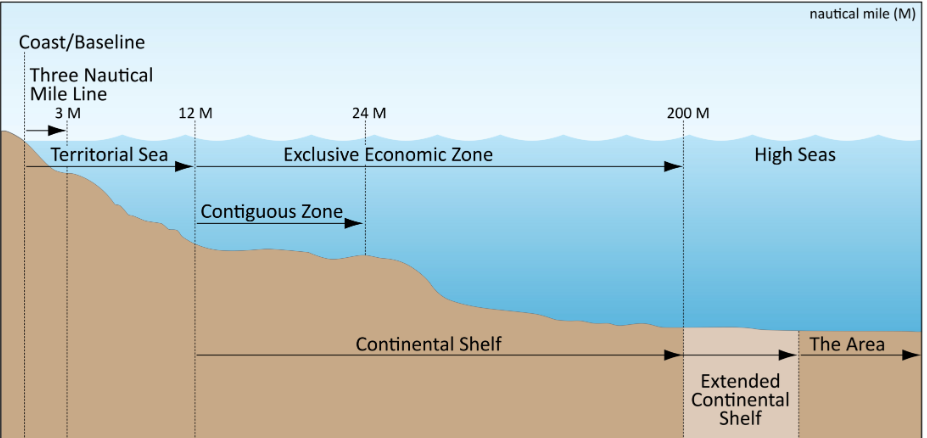
(Image Source: NOAA)
Territorial Sea
- Limit: Up to 12 nautical miles (nm) from the coast (baseline).
- Rights:
- Full sovereignty — like land territory — over the waters, airspace above, seabed, and subsoil.
- Foreign ships enjoy the right of “innocent passage,” but the coastal state controls most activities.
Contiguous Zone
- Limit: From 12 nm up to 24 nm from the baseline.
- Rights:
- Coastal state can enforce laws related to customs, immigration, taxation, and pollution.
Exclusive Economic Zone (EEZ)
- Limit: Up to 200 nm from the baseline (or until it meets another state’s boundary).
- Rights:
- Sovereign rights for exploring, exploiting, conserving, and managing natural resources (living and non-living) in the water, seabed, and subsoil.
- Jurisdiction over marine scientific research, artificial islands, and environmental protection.
Continental Shelf
- Definition: Seabed and subsoil extending from the land territory to either:
- the outer edge of the continental margin, or
- 200 nm from the baseline (whichever is greater).
- Extended Continental Shelf:
- If the natural continental margin stretches beyond 200 nm, a country can claim more — but must submit scientific evidence to the Commission on the Limits of the Continental Shelf (CLCS).
- The shelf beyond 200 nm is called the Extended Continental Shelf.
- Rights:
- Sovereign rights only over the seabed and subsoil (not the water column above — that’s still international waters beyond the EEZ).
- For exploring and exploiting natural resources (e.g., oil, gas, minerals).
Key Distinctions:
| Zone | Limit | Sovereignty/Rights |
|---|---|---|
| Territorial Sea | 12 nm | Full sovereignty (water, seabed, airspace) |
| Contiguous Zone | 24 nm | Law enforcement rights (customs, immigration, etc.) |
| EEZ | 200 nm | Sovereign rights over natural resources (water, seabed, subsoil) |
| Continental Shelf | to outer margin or 200 nm+ | R |


