




Why in News?
The 4,500-year-old Pashupati Seal from the Indus Valley Civilization has become the subject of a debate over India’s civilisational continuity after the Union Culture Ministry described it as a symbol of India’s unbroken cultural heritage, while some historians disputed its interpretation as an early form of Shiva.
About the Pashupati Seal
- The Pashupati Seal was discovered at Mohenjo-daro in the 1920s.
- It was excavated by Ernest Mackay under the leadership of John Marshall.
- The seal (Seal No. 420) belongs to the Mature Harappan Phase and dates to around 2500 BCE.
- It is one of the most famous artifacts of the Indus Valley Civilization.
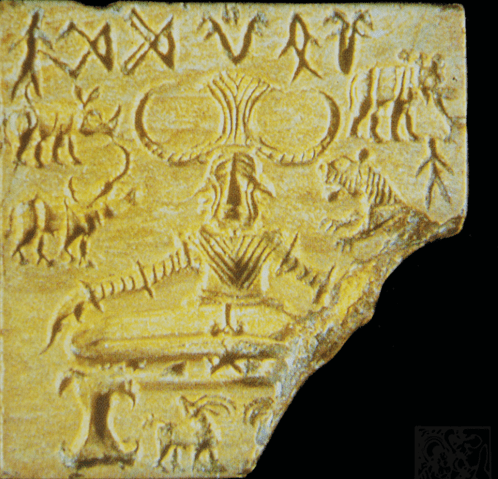
Features of the Seal
- It depicts a central seated figure on a low platform.
- The figure wears a fan-shaped headdress with prominent horns.
- Surrounding the figure are animals:
- Elephant
- Tiger
- Rhinoceros
- Buffalo
- Two deer beneath the seat
- An inscription consisting of seven Indus script characters appears at the top of the seal.
The Proto-Shiva Interpretation
- In 1921, John Marshall proposed that the figure represented Proto-Shiva or Pashupati (Lord of Animals).
- Supporters of this interpretation cite:
- The yogic or meditative posture.
- Association with animals.
- Similarities with later Shaivite symbolism.
- This view has often been used to argue for cultural continuity between the Indus Civilization and later Hindu traditions.
The Current Controversy
- The Union Culture Ministry recently described the seal as a symbol of India’s continuous civilisational heritage.
- Historian Audrey Truschke challenged this interpretation, arguing that the seal does not necessarily depict Shiva.
- She suggested that the imagery may instead be related to broader Eurasian or proto-Elamite iconographic traditions associated with a “Lord of Animals” deity.
Counter-Arguments
- Author Amish Tripathi criticized the proto-Elamite interpretation.
- He argued that animals shown on the seal, such as elephants, rhinoceroses, and water buffaloes, were native to the Indian subcontinent rather than ancient Elam (southwestern Iran).
- According to this view, the seal’s iconography reflects a distinctly South Asian cultural context.
Sources: IE & TP